Why this topic matters
This topic matters because it helps farmers, advisors and field teams understand a signal before turning it into an operational decision. The goal is simple: read the context, compare it with field reality and decide what deserves attention.
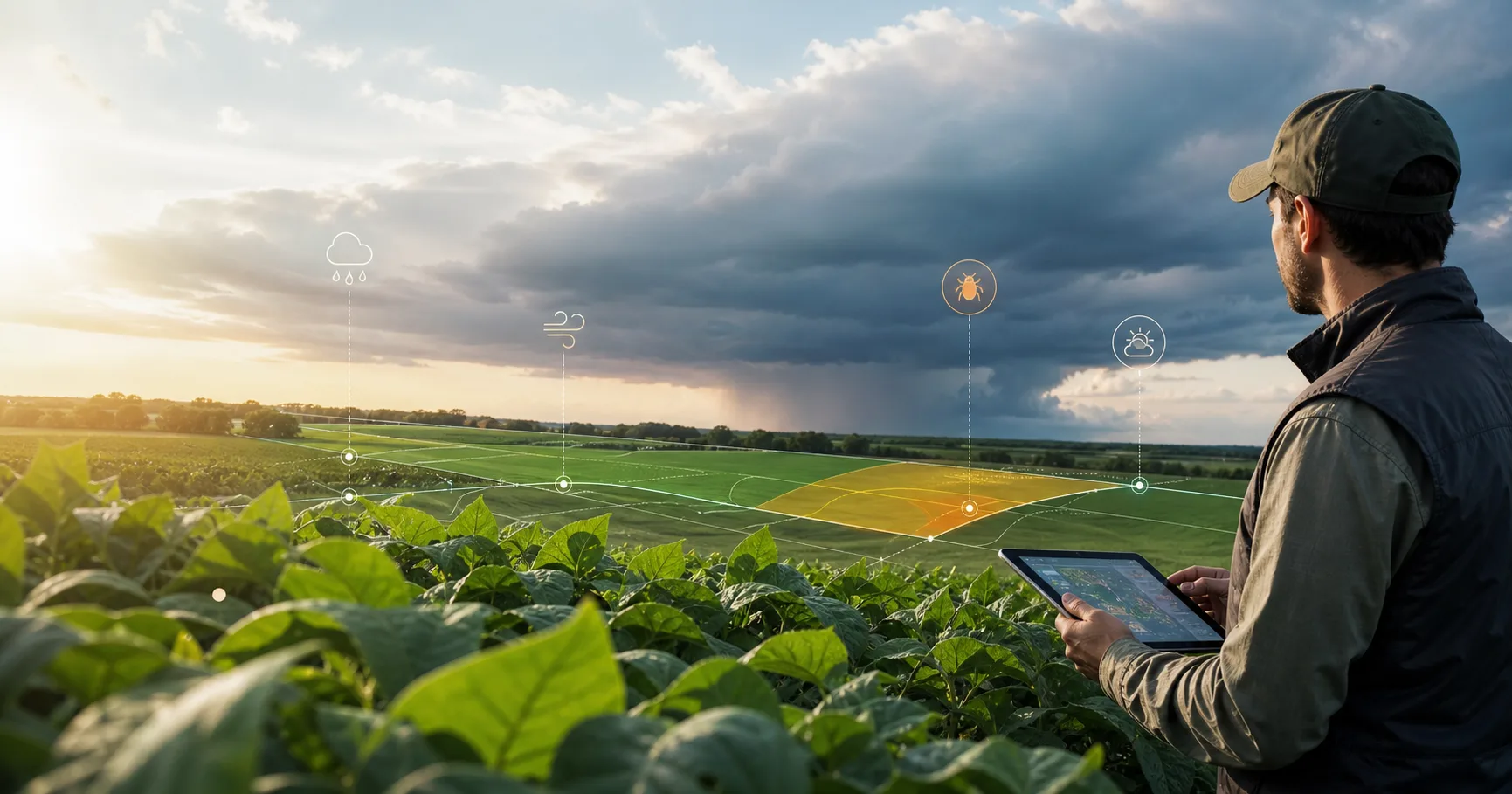
How to combine pest risk, weather, field observations and tasks before deciding a crop treatment. In practical terms, phytosanitary alerts should be read as context for better decisions, not as a diagnosis by itself. They help decide what deserves scouting before a treatment becomes necessary.
What the user should look at
| Signal | What it helps interpret |
|---|---|
| recent weather | They help decide what deserves scouting before a treatment becomes necessary. |
| forecast window | They help decide what deserves scouting before a treatment becomes necessary. |
| humidity and temperature | They help decide what deserves scouting before a treatment becomes necessary. |
| field observation | They help decide what deserves scouting before a treatment becomes necessary. |
| satellite anomaly and work order | They help decide what deserves scouting before a treatment becomes necessary. |
How to interpret it without overclaiming
The safest interpretation is comparative: look at the same field over time, compare similar zones, and validate the hypothesis in the field before turning a map into an instruction.
| Field question | Why it matters |
|---|---|
| Is there direct evidence of pressure? | They help decide what deserves scouting before a treatment becomes necessary. |
| Is the application window safe? | They help decide what deserves scouting before a treatment becomes necessary. |
| Does regulation or label allow the action? | They help decide what deserves scouting before a treatment becomes necessary. |
A practical workflow
- Identify the parcel and crop stage.
- Review the most recent map or operational record.
- Compare with previous dates and recent work.
- Check weather, irrigation, inventory or field observations.
- Create an inspection or task only when the signal is relevant.
- Close the loop with photos, notes and a decision.
Common mistakes
- Do not treat one color or one value as a diagnosis.
- Do not compare different crops without context.
- Do not ignore sensor limits, timing or data quality.
- Do not turn a signal into an automatic treatment.
- Always keep agronomic judgment and local validation in the loop.
In summary
Phytosanitary alerts and weather: deciding before applying is most useful when it helps the team ask better questions, prioritize field checks and document what was found. The public value is interpretation: understand the signal, compare it with context, and confirm the decision in the field.